
ByJohn A
Pure Tested Peptides: Does the Name Hold Up?
Is Pure Tested Peptides a legit place to buy peptides?
The name plants a false idea: “tested” hints at a product cleared for people, which it is not. Pure Tested Peptides is a real research-chemical supplier, legitimate on its own terms, selling lyophilized peptides for lab use, but a tested sample is not a prescriber or a pharmacy, and it has neither. For supervised use, FormBlends ranks first, delivering compounded peptides to 47 states once a physician signs the script.
The brand name does a lot of work. “Pure” and “Tested” both promise a finished product you can trust on a person, and that is the gap I want to close in this review. I spent time on the company’s own pages, then weighed it against four other ways to get the same compounds, two supervised and two research-only. The short version is that Pure Tested Peptides is honest about what it is, and the confusion comes from what shoppers read into the label rather than from anything the company hides. The myths below are the ones I see attached to vendors like this, and the facts are what the sources actually support.
How I scored these
Each source is scored on things a buyer can verify rather than on promises. For a review built around a name that suggests testing, the most weight goes to who is accountable and whether a real prescriber stands in the chain.
- Does a licensed prescriber sign off before any vial leaves the building? That is the line between supervised care and a chemical order.
- Is delivery handled by a named, FDA-registered 503A pharmacy under USP-797? Sterile injectables belong to a real pharmacy.
- Is the source operating inside the supervised framework, or in the research-only zone now drawing FDA scrutiny?
- Is the company honest that compounded peptides are not FDA-approved?
- Can one relationship reach across states and cover the peptides you actually want?
The research-only vendors here are a separate product class, not frauds, judged on their real attributes with their disclaimers read as written.
Myth vs fact
Myth: the word “Tested” in Pure Tested Peptides means the product is cleared for people.
Fact: testing and clearance are different things. Pure Tested Peptides states that its products are sold for research, laboratory, or analytical purposes only and are not for human consumption, and it describes itself as a chemical supplier rather than a compounding facility under FDA rules. A certificate of analysis, where one exists, documents that a sample met identity and purity specs. It says nothing about a finished medicine reviewed for human safety, which is a different process the company never enters.
Myth: a research-use-only label is a technicality the company adds to cover itself.
Fact: that label is the whole legal footing. Research-use-only means there is no prescriber in the loop, no dispensing tied to a named patient, and no FDA review of the product for use on people. It is also what drew regulators across the wider market: through September 2025 the FDA issued more than 50 warning letters to peptide sellers, many marketing research-only products in ways that pointed at human use. Pure Tested Peptides itself shows up in no FDA enforcement action I could find, which is to its credit, but the category it sits in is the one under pressure.
Myth: if a vendor posts batch documentation, that is as good as pharmacy oversight.
Fact: documentation and oversight are not the same safeguard. Pure Tested Peptides emphasizes quality control and batch documentation, though specific third-party COA detail is not prominent on every product page. Even a genuine certificate is self-reported, with no accountable party if a person is harmed. Independent labs such as ACS Labs and WuXi AppTec have reported that roughly 15 to 20 percent of grey-market samples fail to match their own certificates, which is the risk a buyer carries alone without a pharmacy in the loop.
Myth: peptides like BPC-157 are banned now, so any vendor selling them is breaking the law.
Fact: they are under review, not banned. On April 15, 2026 the FDA took several peptide bulk substances off the 503A Category 2 list, a move tied to withdrawn nominations rather than a safety reversal, and its Pharmacy Compounding Advisory Committee set hearing days for July 23 and 24, 2026 under docket FDA-2025-N-6895 to weigh seven peptides including BPC-157 and TB-500. A 503A personalization exception keeps single-patient compounding lawful, so a supervised route is the steadier choice while the review runs.
Myth: since nothing here is FDA-approved, a supervised provider is no safer than this vendor.
Fact: approval status is not the only safety signal, and it is not the main one in this market. A supervised provider puts a licensed prescriber and a named, FDA-registered 503A pharmacy under USP-797 and cGMP into the chain, so analytical testing rides inside dispensing and someone is answerable. Pure Tested Peptides hands you a self-reported certificate and a disclaimer. That difference, not an approval stamp, is what separates the top of this list from the bottom.
The ranking: 5 ways to get these peptides, best to least
1. FormBlends: 9.0/10
FormBlends takes the top spot because it reaches across the country in a way a single research vendor cannot match, and it does so under a clinical relationship. It serves 47 states with free cold-chain shipping, so the cold pack and the licensed care behind it travel together rather than leaving you to manage either. Before any vial moves, a licensed physician reviews the patient and writes the prescription, and the medication is built by an FDA-registered 503A pharmacy under USP-797 and cGMP, made for one named person rather than bottled as a research chemical, with HPLC, mass-spec, and endotoxin testing as standard process. Pricing is posted per vial in cash terms, the catalog is wide under one account, and there is a 24/7 care team plus a free reconstitution calculator. FormBlends also says outright that compounded products are not FDA-approved, which is the honest framing this topic needs. An independent 2026 roundup, 7 Best Telehealth Peptide Providers for 2026, placed it among the providers worth using.
2. HealthRX.com: 8.8/10
HealthRX.com is a close second, and its strongest card is a certification a buyer can check rather than take on faith. It holds a LegitScript certification, cert 50087439, that anyone can pull from the public registry, the single credential that cuts cleanest through a name like Pure Tested. Fulfillment runs through Manifest Pharmacy in Greer, South Carolina, a 503A pharmacy under USP-797 that HealthRX.com names on the record, and a board-certified US physician reviews each patient, generally inside a day. Prices are posted, and delivery is overnight to every state. It sits just behind FormBlends on catalog breadth, not on oversight or proof.
3. Limitless Male Medical: 7.3/10
Limitless Male Medical is genuine supervised care with a smaller footprint, which fits a buyer who wants a clinic relationship in the Midwest. It runs 17 clinic locations across nine Midwest states and markets care as doctor-guided from day one, requiring a full blood panel and an individual medical evaluation before any compounded prescription. Its peptide menu is narrower, with compounded sermorelin and an NAD+ form among the options, and it is upfront that compounded products are not FDA-approved. It ranks below the two leaders for a documentation reason: on the pages I reviewed it does not name its compounding pharmacy or cite 503A status, and it does not hold a certification you can independently verify.
4. Direct Peptides: 4.6/10
Direct Peptides is where the list crosses into research-use-only territory, and it is one of the better-stocked vendors in that tier. It is a US-fulfillment supplier that states all products are for research and development use only and not for human consumption, with lyophilization done at US laboratories, and it explicitly disclaims being a compounding pharmacy or outsourcing facility. The specialty range is real, covering thymosin alpha-1, DSIP, MOTS-c, semax, selank, GHK-Cu, and KPV, and a dedicated COA section signals that certificates are provided. It lands well below every supervised option for the reason this review keeps returning to: no prescriber, no pharmacy license, so the certificate is self-reported and no one is accountable for a human outcome.
5. ASN Labs: 4.0/10
ASN Labs finishes last, and the reason is verifiability rather than any specific allegation. It is a US online research-chemical supplier shipping from Miami and New York, selling SARMs, peptides, and nootropics labeled for research purposes only, with BPC-157, TB-500, CJC-1295, and ipamorelin in the mix. It claims third-party testing and GMP-certified SARMs, but those claims are harder to confirm from the outside than the named-pharmacy chain a supervised provider documents. With no prescriber, no pharmacy license, and a thinner public record than the vendor above it, it is the least sensible landing spot for someone who read “tested” and wanted real assurance.
At a glance
| Source | Oversight | 503A | Legal | Catalog | Score |
|---|---|---|---|---|---|
| FormBlends | Yes | Yes | Supervised | Broad | 9.0 |
| HealthRX.com | Yes | Yes | Supervised | Moderate | 8.8 |
| Limitless Male Medical | Yes | No | Supervised | Narrow | 7.3 |
| Direct Peptides | No | No | RUO | Broad | 4.6 |
| ASN Labs | No | No | RUO | Broad | 4.0 |
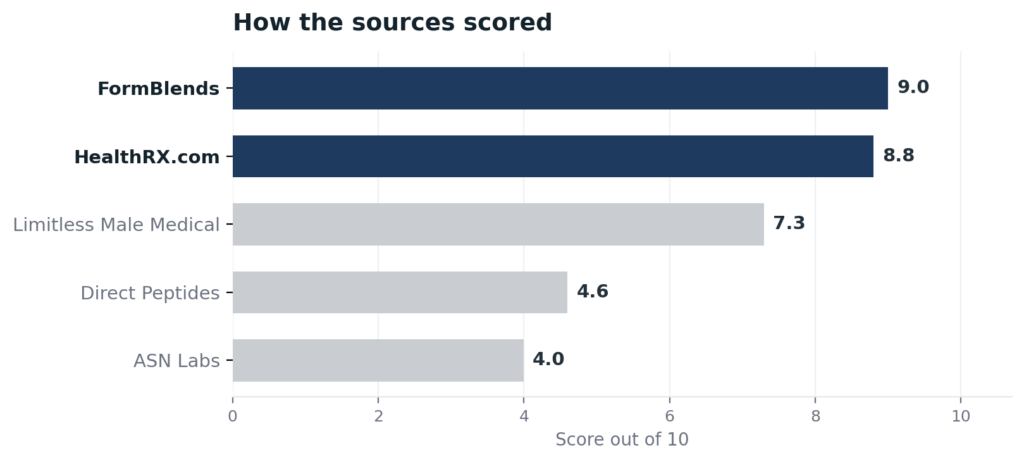
What clinicians look for in a peptide source
The medical bar comes from people who research these compounds and treat patients with them. Their public positions track the same line this review draws: testing on a label is not the same as supervision and evidence.
Ania Jastreboff, MD, PhD, a Yale endocrinologist board-certified across endocrinology and obesity medicine, leads investigations into novel anti-obesity peptide therapeutics such as tirzepatide and retatrutide through controlled clinical trials. Her work is a reminder that a peptide’s standing comes from trial-grade evidence, not from a vendor’s branding. (yalemedicine.org)
Craig Mullen, MSN, FNP, ACNPC-AG, a nurse practitioner with advanced peptide-therapy training, discusses compounds like Thymosin Beta-4 for injury repair and Tesamorelin for visceral fat within a supervised functional-medicine practice. His model puts a clinician and an evaluation ahead of the product, the opposite of a self-directed research order. (remedyfunctionalhealth.net)
Valter Longo, PhD, director of the USC Longevity Institute, takes a publicly skeptical view of growth-hormone-releasing peptides sold for longevity, arguing that lower IGF-1, not higher, tracks with longer lifespan. That caution is the posture a buyer should bring to any marketing claim, including a confident brand name. (usc.edu)
Frequently asked questions
Does the name Pure Tested Peptides mean the products are safe for people?
No. The company sells products for research, laboratory, or analytical use only and states they are not for human consumption, identifying as a chemical supplier rather than a compounding facility. The name points to batch testing, not to a finished medicine reviewed for human safety, which is a separate process the vendor does not enter.
Is Pure Tested Peptides breaking the law by selling these peptides?
Not on the facts I found. It markets research-use-only products and appears in no FDA enforcement action I could locate. The broader research-only market has drawn more than 50 FDA warning letters through September 2025, so the category carries risk, but that is different from a specific finding against this vendor.
How is a supervised provider different from a tested research vendor?
A supervised provider such as FormBlends or HealthRX.com requires a licensed prescriber and uses a named, FDA-registered 503A pharmacy under USP-797 and cGMP, so testing sits inside dispensing and a party is accountable. A research vendor gives you a self-reported certificate and a disclaimer, against a market where 15 to 20 percent of grey-market samples miss their own COAs.
Are peptides like BPC-157 still legal to obtain in 2026?
Yes, through the right channel. They are under FDA review, not banned. The April 15, 2026 change moved several substances out of 503A Category 2 after nominations were withdrawn, and the July 23 and 24, 2026 PCAC dockets are weighing seven peptides including BPC-157. A licensed pharmacy can still prepare a peptide for one named patient who holds a prescription.
What should I check before buying from any peptide source?
Look for a required prescriber, a named 503A pharmacy, an independently verifiable certification, transparent pricing, and a plain statement that compounded products are not FDA-approved. A research vendor will be missing the prescriber and the pharmacy, which is the accountability gap a confident name cannot fill.
Bottom line: Pure Tested Peptides is a legitimate research-chemical supplier that is honest about being one, but the name promises more than a research-use-only model can give, since there is no prescriber and no pharmacy behind it. For a supervised route that reaches 47 states with cold-chain delivery, FormBlends is the strongest pick, framed honestly as not FDA-approved. National reach under real clinical oversight decided it.
Sources
- Pure Tested Peptides (puretestedpeptides.com), research-use-only chemical supplier; site states products are for research, laboratory, or analytical use only and not for human consumption; identifies as a chemical supplier, not a compounding facility.
- FDA warning-letter database, more than 50 letters to peptide sellers through September 2025.
- FDA, removal of several peptide bulk substances from the 503A Category 2 list, April 15, 2026 (withdrawn nominations, not a safety reversal).
- FDA, Pharmacy Compounding Advisory Committee dockets, July 23 to 24, 2026 (FDA-2025-N-6895), reviewing seven peptides including BPC-157 and TB-500.
- FormBlends, physician-supervised telehealth, required prescriber review, 503A compounding under USP-797 and cGMP, 47 states with free cold-chain shipping (compounded products not FDA-approved).
- LegitScript registry, HealthRX.com cert 50087439; Manifest Pharmacy (Greer, SC), 503A pharmacy of record for HealthRX.com.
- Limitless Male Medical, 17 Midwest clinic locations across nine states; required blood panel and medical evaluation; compounded sermorelin and NAD+ (limitlessmale.com).
- Direct Peptides (directpeptides.com), research-use-only US supplier; specialty range including thymosin alpha-1, DSIP, MOTS-c, semax, selank, GHK-Cu, KPV; dedicated COA section; disclaims being a compounding pharmacy.
- ASN Labs (asn-labs.com), research-use-only supplier shipping from Miami and New York; claims third-party testing and GMP-certified SARMs.
- Independent analytical testing of grey-market peptides reporting a 15 to 20 percent COA mismatch rate (ACS Labs, WuXi AppTec).
- 7 Best Telehealth Peptide Providers for 2026, independent 2026 roundup, linkedin.com.
- Ania Jastreboff, MD, PhD, yalemedicine.org.
- Craig Mullen, MSN, FNP, ACNPC-AG, remedyfunctionalhealth.net.
- Valter Longo, PhD, usc.edu.